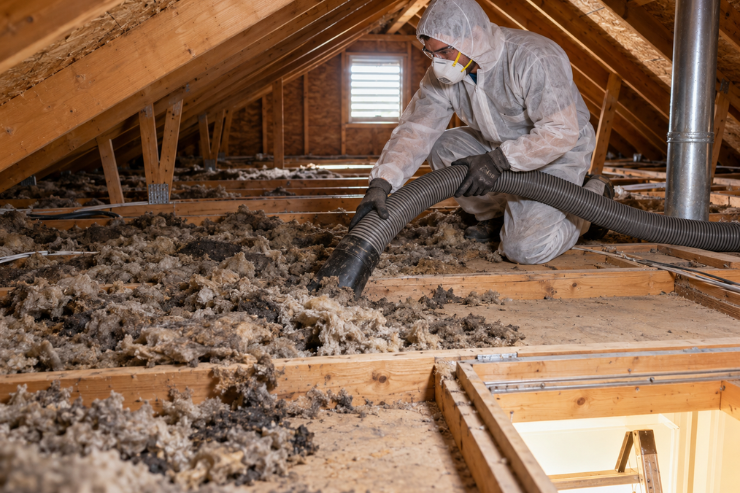
You peek into the attic and see old insulation that looks tired. Or a quote arrives for a top-up, and you wonder if that’s really the right step. It’s a fair question, because the wrong choice can mean paying twice. This guide explains the signs that point to attic insulation removal that Toronto homeowners should know, when a top-up is enough, what to know about older vermiculite, and how costs and rebates fit in.
Both options are valid. The right one depends on the condition of what’s already up there.
| Top-up usually fits | Removal usually fits |
| Dry and clean | Wet, damp or mouldy |
| Fluffy but thin | Soiled by pests |
| Joists easy to see | Smoke or fire damage |
| No odours | Flattened, matted or very old |
A quick look from the attic hatch often shows which column your attic belongs in, and a professional can confirm it.
These are the signs that most often call for starting fresh:
A safe way to check:
Often, yes. If the insulation is dry, clean, and just thin, adding more on top is a common route. An attic insulation top-up Toronto homeowners choose usually makes sense when:
It also helps to seal air leaks and check attic ventilation first, so the new layer can do its job. Our attic insulation top-up service is one way to go about it.
Vermiculite is loose, lightweight, and pebble-like, usually grey, brown, or gold. Federal guidance says it’s prudent to assume vermiculite insulation made before 1990 may contain some asbestos. You can read more in the vermiculite guidance from the Canadian Centre for Occupational Health and Safety.
If you think you have it:
If a test comes back positive, removal is a specialized job for an asbestos-qualified professional. That is a separate service with a separate cost.
Steps vary by company, but a typical job looks like this:
Crews commonly allow roughly three to eight hours, depending on attic size and access. Clearing a path to the hatch and moving stored items helps the day go smoothly.
Prices vary from home to home. Published GTA guides commonly put attic insulation removal in Toronto homes at about $1.50 to $4.00 per square foot. Here’s what that looks like for common attic sizes:
| Attic Size | Approx. Removal Only |
| About 600 sq ft | $900 to $2,400 |
| About 1,000 sq ft | $1,500 to $4,000 |
| About 1,200 sq ft | $1,800 to $4,800 |
What moves the price:
Vermiculite that tests positive is priced separately and is usually much higher. Testing is commonly quoted at about $300 to $800.
Please note these are market estimates. Book an appointment with us for a price based on your own home.
Ontario’s Home Renovation Savings program has a standalone attic stream. Reported details for attic insulation Toronto homeowners often ask about:
Check the official Home Renovation Savings site for current rules, including which costs count before you book.
Top-up and removal each have a place. A dry, clean attic with thin insulation often suits a top-up, while moisture, pests, smoke damage, or very old material can point toward starting fresh. Any suspected vermiculite should be tested first. You know your home best, so take a safe look from the hatch, note what you see, and compare your options.
If you’d like a second opinion on attic insulation removal choices in Toronto, Universal Duct Cleaning has served Toronto and the GTA since 2002 and offers attic insulation removal, top-up, and new installation. You can request a free quote to talk it through.
Q1. Can I add new insulation on top of old insulation? Yes, when the old insulation is dry, clean, and in good shape. If it’s wet, mouldy or pest-damaged, it’s usually removed first so the new layer starts clean.
Q2. How long does attic insulation removal take? Most standard attics take roughly three to eight hours, depending on size, material and access. A small hatch or heavy contamination can add extra time.
Q3. Do I need to remove insulation after rodents or squirrels? Often, yes. Droppings and urine soak into insulation and can leave odours, so many homeowners remove the affected material and have entry points sealed afterwards.
Q4. How often should attic insulation be replaced? There’s no fixed date. Many guides suggest 15 to 20 years for blown-in insulation, but condition matters more than age, so check for moisture, pests and compression.
Q5. Can I remove attic insulation myself? It’s possible with plain fibreglass or cellulose, but it’s dusty work and you must stay on the joists. If you suspect vermiculite, don’t touch it until it’s tested.
Universal Duct Cleaning serves Toronto, Brampton, Mississauga, Vaughan, and the full GTA. Call for a free quote.
Book a free quote with Universal Duct Cleaning Inc. No pressure, no hidden fees.