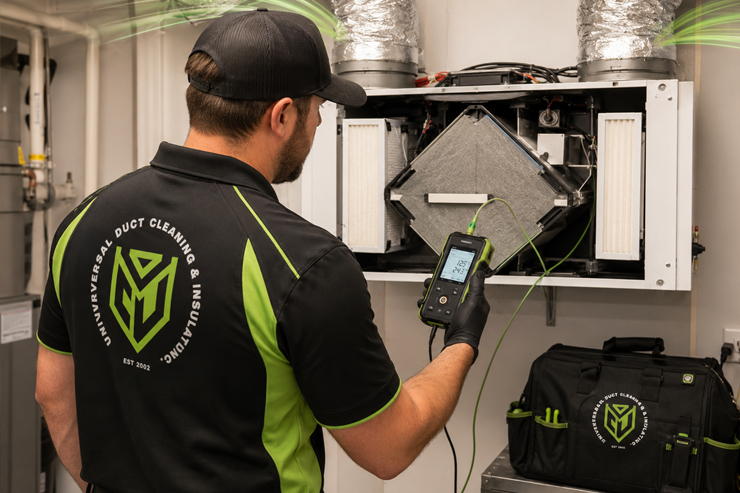
A Heat Recovery Ventilator (HRV) is designed to bring fresh outdoor air into your home while recovering heat from the outgoing stale air—keeping your home comfortable and properly ventilated without wasting energy. Over time, dust, dirt, and debris can accumulate within the HRV unit, filters, and ductwork, reducing efficiency and airflow.
A Heat Recovery Ventilator (HRV) is designed to bring fresh outdoor air into your home while recovering heat from the outgoing stale air — keeping your home comfortable and ventilated without wasting energy. But HRVs need regular cleaning to function properly. A dirty HRV core, clogged filters, or blocked hoods can significantly reduce effectiveness and indoor air quality. Universal Duct Cleaning provides professional HRV cleaning and airflow balancing for homes and buildings across Toronto and the GTA.
Modern airtight homes rely on HRVs for fresh air. A dirty HRV in a tightly sealed home significantly affects indoor air quality.
If your home feels stuffy or overly humid in winter, your HRV may not be moving air effectively.
If indoor air feels stale despite having an HRV running, the unit may need cleaning or rebalancing.
HRVs are commonly overlooked. If yours has never been professionally cleaned, it's likely due.
Noticeably weaker airflow from HRV terminals is a sign of a clogged core or filters.
Frost formation on the HRV core in winter can indicate airflow imbalance or filter blockage.
The HRV core (heat exchange media) is carefully removed and cleaned to restore heat transfer efficiency.
HRV filters cleaned or replaced to restore proper airflow and prevent contamination of the core.
The condensate drain pan inside the HRV is cleaned to prevent blockage and water buildup.
Both exterior intake and exhaust hoods are inspected and cleared of debris, insect nests, or obstructions.
We check and balance airflow between fresh air intake and stale air exhaust for proper HRV operation.
Overall inspection of the HRV unit, defrost cycle settings, and duct connections for visible issues.
We gather information about your HRV model and home to estimate the scope of work before arriving.
Technician inspects the full HRV unit — core, filters, drains, hoods, and airflow — before beginning.
HRV core removed and cleaned, filters maintained, drain cleared, and hoods inspected.
Airflow balanced and checked for proper operation before we complete the service.
HRVs should be inspected and cleaned at least once a year, typically in spring or fall. Homes with higher occupancy or heavy use may benefit from more frequent cleaning.
An HRV (Heat Recovery Ventilator) is a whole-home ventilation system that exchanges stale indoor air for fresh outdoor air while recovering heat. The internal core and filters accumulate dust, debris, and biological matter over time, reducing effectiveness.
Yes. A clogged HRV core or filter restricts airflow, reduces the system's ability to exchange air effectively, and can contribute to stale or humid indoor air.
HRV cleaning typically takes 1–2 hours for a standard residential unit. More complex or heavily soiled systems may take longer.
Yes. Most new homes built to modern energy codes include an HRV. These units need regular cleaning to maintain effectiveness — many homeowners are unaware of this requirement.
Book a free quote with Universal Duct Cleaning Inc. No pressure, no hidden fees.