If your home was built in the last fifteen years, there is a good chance it has an HRV system. Most homeowners know it is there. Very few know what it does or that it needs regular cleaning to keep doing it.
This blog explains what an HRV actually is, why it matters in newer Toronto homes and condos, and what happens when it is not maintained.
Older homes had gaps in the walls, around windows, under doors. That was not ideal for heating bills, but it did mean the home got some natural airflow. Fresh air came in. Stale air moved out. Not efficiently, but it happened.
Newer homes are built differently. They are tightly sealed for energy efficiency, which is great for your hydro bill but means the home cannot breathe on its own. Without a mechanical system bringing in fresh air, the same air just keeps circulating inside.
That is where the HRV comes in.
An HRV or Heat Recovery Ventilator pulls stale indoor air out and brings fresh outdoor air in. At the same time, it captures the heat from the outgoing air and transfers it to the incoming air. You get fresh air without losing the warmth you already paid to heat. In Toronto’s winters, that matters.
Because of the tight construction of new homes, your home can no longer breathe on its own. An HRV allows for fresh air exchange by exhausting stale indoor air and supplying an equal volume of fresh air from outside, ensuring high quality indoor air year-round.
For condos specifically, this is not optional. Toronto’s building code requires mechanical ventilation in modern high-rises because suites are sealed tight for energy efficiency. Your HRV or ERV is doing a job your building was designed to depend on.
Here is the part most homeowners miss.
Your HRV has filters that catch dust, debris, and airborne particles as air moves through the system. Over time, those filters get clogged. When that happens, the system cannot move air the way it is supposed to.
The result is not dramatic, it is gradual. The air inside your home starts to feel a little stale. Humidity levels creep up or drop too low depending on the season. Cooking smells linger longer than they should. In winter, you may notice more condensation on your windows.
None of these feel like an emergency. But they are all signs that your HRV is not doing its job properly.
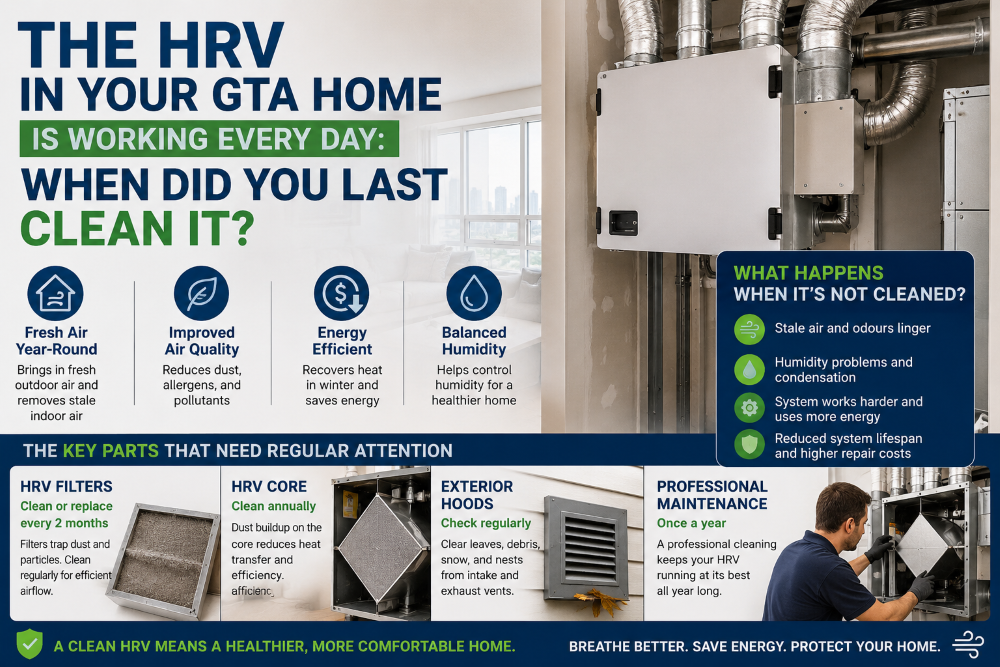
Dirty filters and clogged cores block fresh air, increase humidity, and force the unit to work harder. Over time, that puts unnecessary strain on the system and reduces its lifespan.
The filters in your HRV are the first line of defence. They need to be cleaned more often than most homeowners realise.
Dirty or clogged filters can lower ventilation efficiency. You should clean or replace your filters every 2 months. Filters in most new HRVs can be easily removed, vacuumed, and washed with mild soap and water.
For condos and homes in areas with higher dust levels – near construction, busy roads, or older buildings, filter changes may be needed every 3 to 6 months.
Cleaning the filters is something some homeowners can do themselves if the unit is accessible. But the core, the internal component where heat transfer actually happens, needs a different level of attention.
The core is the heart of the HRV system. It is where the outgoing and incoming air streams pass close to each other, transferring heat without actually mixing. Over time, dust and debris build up on the core and reduce how efficiently that heat transfer happens.
Vacuuming the core and washing it with soap and water will reduce dust that can build up inside the core. This is typically done as part of an annual professional service and is not something most homeowners can do effectively on their own.
A dirty core does not just reduce air quality, it means your system is working harder to recover less heat. That affects your energy use and the overall comfort of your home.
Your HRV has two openings on the outside of your home, one that brings fresh air in and one that pushes stale air out. Both have hoods or grilles that protect them from weather and pests.
These get blocked. Leaves, debris, bird nests, and in winter, ice and snow can all restrict airflow at the exterior. When the intake is blocked, your HRV is essentially trying to breathe through a closed mouth.
Pay extra attention to the intake vent, which is often prone to blockages from insects and debris, make sure to clean the screens. Ensure that the vents are free from snow or ice buildup, especially during winter.
Checking and clearing the exterior hoods is a simple step that makes a real difference to how well your system performs, especially going into a Toronto winter.
One thing that surprises many homeowners is that their HRV plays a role in managing indoor humidity, not just air quality.
In winter, Toronto homes can get very dry when windows are sealed and heating systems run constantly. In summer, humidity can creep up and make the home feel heavy and uncomfortable. A properly functioning HRV helps balance this by continuously exchanging indoor and outdoor air.
HRVs can help mitigate high indoor humidity during the cooler winter months of the year by exchanging the humid indoor air with the drier air from outside.
When the system is dirty or blocked, that balance is off. You may notice dry skin and static in winter, or a clammy feeling in summer, both signs that the air exchange is not happening the way it should.
A proper HRV service goes beyond wiping down the filters. A thorough cleaning typically includes:
To maintain optimal performance of your HRV, it is recommended to perform cleaning in the spring and fall. For most Toronto homes and condos, an annual professional service, ideally paired with your regular duct cleaning, keeps the system running the way it was designed to.
In an older home, a little fresh air always found its way in. In a newer build or condo, your HRV is the only system doing that job. When it is clean and working properly, the difference in how your home feels is noticeable – clearer air, steadier humidity, and fewer lingering smells.
When it is neglected, the effects are gradual but real. Most homeowners do not connect the stuffiness or dry air to their HRV until someone points it out.
If your home was built in the last fifteen years and you cannot remember the last time your HRV was serviced, it is worth having Universal Duct Cleaning take a look. It is a straightforward service and one that makes a quiet but meaningful difference to the air you breathe every day.
Q1: What is the difference between an HRV and an ERV?
Both systems exchange stale indoor air with fresh outdoor air. An HRV transfers heat only, making it better suited to cold climates like Toronto where indoor air tends to get too humid in winter. An ERV transfers both heat and moisture, which works better in climates with hot, humid summers. Most newer Toronto condos use ERVs, while many detached homes use HRVs. If you are not sure which one you have, a technician can confirm during a service visit.
Q2: How often does an HRV need to be professionally cleaned?
Most Toronto condo ERVs and HRVs need filter changes every 3 to 6 months and full maintenance including core cleaning annually. Homes with pets, allergy-sensitive residents, or proximity to construction may need more frequent attention. A quick filter check every couple of months is a good habit between professional visits.
Q3: Can I clean my HRV myself?
You can clean or vacuum the filters yourself if the unit is accessible and it is worth doing regularly. However, cleaning the core, checking the condensate drain, inspecting the motor, and testing airflow balance are best handled by a professional. Doing a partial job on the filters while leaving the core and exterior hoods unchecked means the system is still not performing at full capacity.
Q4: What are the signs my HRV needs cleaning?
The most common signs are stale or stuffy air that does not clear even with windows open, higher than usual humidity in winter or summer, cooking smells or odours that linger, increased condensation on windows, and a general feeling that the air inside the home is heavier than it should be. If you notice any of these in a newer home or condo, the HRV is usually the first place to look.
Q5: Is HRV cleaning included in a standard duct cleaning service?
Not always, it depends on the company and what their service covers. HRV cleaning is sometimes offered as a standalone service or as an add-on to a full residential duct cleaning. Always ask specifically whether HRV filter cleaning, core cleaning, and exterior hood inspection are included before you book. A reputable duct cleaning company in Toronto will be clear about what the service covers.
Q6: Is duct cleaning recommended after a renovation?
Yes and it is one of the most justified reasons to book a service. Renovation work creates a lot of fine dust and debris from drywall cutting, sanding, flooring, and insulation work. Even if your vents were covered during the renovation, particles still make their way into the duct system. Getting your ducts cleaned after any major renovation helps clear that buildup before it keeps circulating through your home.
Q7: How soon after sanding or renovation work should I book duct cleaning?
As soon as the renovation is fully wrapped up and the dust has settled, usually within a few weeks of completion. The longer you wait, the more that fine dust from sanding and construction gets pulled through your HVAC system and spreads to other areas of the home. Universal Duct Cleaning can assess the condition of your ducts after renovation work and let you know exactly what needs to be done.
Q8: What kind of equipment is used for a professional duct cleaning?
A proper duct cleaning should be done using portable commercial grade equipment, high-powered vacuum systems strong enough to pull debris from the full length of your duct runs. This type of equipment is far more effective than smaller consumer-grade tools. When booking a service, it is worth asking what equipment will be used, as the strength and quality of the equipment directly affects how thorough the cleaning will be.
Universal Duct Cleaning serves Toronto, Brampton, Mississauga, Vaughan, and the full GTA. Call for a free quote.
Book a free quote with Universal Duct Cleaning Inc. No pressure, no hidden fees.