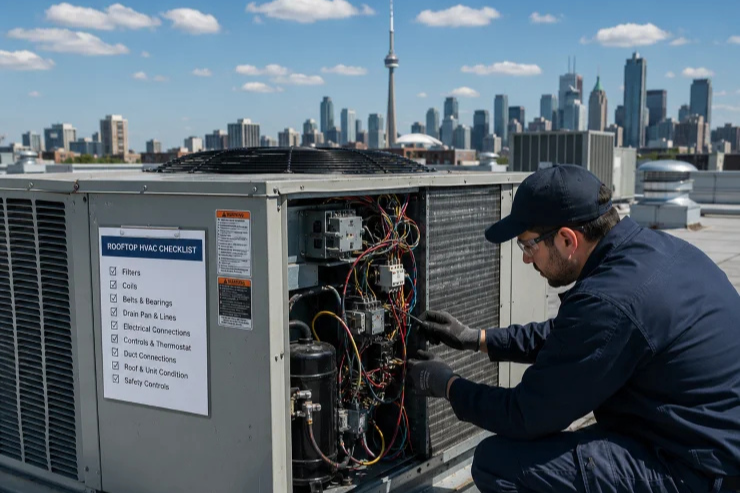
If you manage a commercial property in Toronto or the GTA, your rooftop HVAC unit works hard all year, through humid summers and cold Ontario winters, usually without much attention until something goes wrong.
Out of sight means out of mind. And by the time a tenant complaint or a system failure forces the issue, a simple maintenance task has often turned into a costly repair.
This checklist covers what to inspect, what to watch for, and when to call a professional, broken down by component and season.
Rooftop HVAC units face conditions that ground-level equipment does not:
A well-maintained rooftop unit can last 15 years or more. A neglected one often fails well before that. The cost of replacement, plus lost tenant comfort during downtime is significantly higher than the cost of regular upkeep.
Preventive maintenance keeps the system running efficiently, keeps energy costs in check, and keeps tenants comfortable season to season.
Each of these components plays a direct role in how well your rooftop unit performs. Skipping any one of them is where small issues turn into bigger problems.
Air filters are the first line of defence for your rooftop HVAC system. When they are clogged:
For most commercial buildings in Toronto, filters should be inspected monthly and replaced based on what you find, not on a fixed schedule. Buildings near construction sites, on busy roads, or with high occupancy will go through filters faster.
A rough guide for filter replacement:
Filter replacement is one of the few tasks building staff can handle without a licensed technician. Keep a log of replacement dates and filter conditions, it gives you useful data over time.
Your rooftop unit has two coils that need regular attention:
Both collect dirt over time. Dirty coils reduce how efficiently the system transfers heat, which means longer run times, higher energy use, and more wear on the compressor.
The condenser coil in particular takes a beating on the roof. Leaves, dust, cottonwood seeds in late spring, and airborne debris all collect on the fins. A seasonal clean before peak demand makes a noticeable difference in how well the unit performs.
Coil cleaning is a task for a professional, the fins are delicate and require the right tools and cleaning solutions to avoid damage.
Most rooftop units use belt-driven blowers to move air through the building. Here is what to watch for:
A technician doing a seasonal inspection will check all three as part of the visit.
When the rooftop unit is in cooling mode, it produces condensate, water that collects in a drain pan and exits through a drain line. When either is blocked:
Check drain pans and condensate lines at the start of the cooling season and again mid-summer. Clear any blockages, confirm the pan is draining properly, and look for standing water or residue that points to a slow drain. It is a quick check but one that gets skipped more often than it should.
Rooftop units vibrate constantly during operation. Over time, that vibration loosens electrical connections and a loose connection is both a performance issue and a safety concern.
A qualified technician should inspect the following at least once a year:
Thermostat and controls should also be verified at the start of each season:
A thermostat that is even slightly off can run the system harder than needed and the extra cost adds up over a full season without anyone noticing.
Some noise is normal. A change in noise is not. Watch for:
Tenant complaints about uneven temperatures or rooms that are harder to heat or cool are useful information. Keeping a simple log of when and where complaints come in, it gives a technician a head start before they even get on the roof.
If any of these signs appear between scheduled inspections, book a service call rather than waiting for the next scheduled visit.
Safe access is the first requirement for any rooftop maintenance visit. Before every inspection, confirm:
In GTA winters, snow and ice accumulate on and around rooftop units. Ice blocking the intake or exhaust areas restricts airflow and puts the system under stress. After heavy snowfall, a quick rooftop check to clear the area around the unit is worth the few minutes it takes.
Also check the rooftop membrane and drainage around the unit periodically. Water that pools around the unit base accelerates corrosion and can eventually work its way inside.
For commercial buildings in Toronto and the GTA, two full inspections per year is the standard, one in spring before cooling season and one in fall before heating season. Monthly filter checks happen in between.
Spring inspection – before cooling season:
Fall inspection – before heating season:
Larger buildings with multiple rooftop units, or facilities running around the clock, may benefit from quarterly visits. The right frequency depends on building size, occupancy type, and how hard the system runs.
A rooftop unit that has been looked after consistently is far easier to manage than one that has been left and is now showing problems. Most of the items on this checklist are straightforward when done on schedule and significantly more complicated when they have been left too long.
If your building’s rooftop HVAC is overdue for an inspection, or if you are not sure when it was last properly serviced, Universal Duct Cleaning can assess the system and give you a clear picture of where things stand with no unnecessary upsells, just an honest look at what your building actually needs.
Q1: How often should commercial rooftop HVAC units be serviced?
Twice a year, spring and fall is the standard for most commercial buildings in Toronto and the GTA. Buildings with higher occupancy or 24-hour operations may need quarterly commercial HVAC cleaning inspections.
Q2: What are the most common signs a rooftop unit needs attention?
Watch for unusual noise, weaker airflow, rising energy bills, and tenant complaints about uneven temperatures. These often point to dirty coils, a worn belt, or a blocked filter, all easy to fix when caught early.
Q3: Can building staff handle any rooftop HVAC maintenance?
Filter replacement and basic visual checks are manageable for building staff. Coil cleaning, electrical checks, belt inspection, and blower servicing require a licensed commercial HVAC technician in Toronto with the right equipment and training.
Q4: What happens if rooftop HVAC maintenance is skipped?
Efficiency drops gradually, energy costs rise, run times get longer, and parts wear out faster. A unit that could last 15 years with proper commercial HVAC maintenance may fail in 10 without it.
Q5: Is commercial HVAC cleaning different from residential duct cleaning?
Yes. Commercial HVAC cleaning in Toronto covers larger duct systems, rooftop units, air handlers, and multiple zones. It requires commercial-grade equipment and experienced technicians, very different in scale from standard residential duct cleaning services.
Universal Duct Cleaning serves Toronto, Brampton, Mississauga, Vaughan, and the full GTA. Call for a free quote.
Book a free quote with Universal Duct Cleaning Inc. No pressure, no hidden fees.