You vacuum the living room, and twenty minutes later you’re sneezing again. It makes you wonder if the dust ever really left the room, or just got stirred up and resettled.
Central vacuum systems are often mentioned as a cleaner alternative, but what does that actually mean for the air you breathe? Here’s what the filtration, maintenance, and dust handling look like, so you can weigh it for yourself.
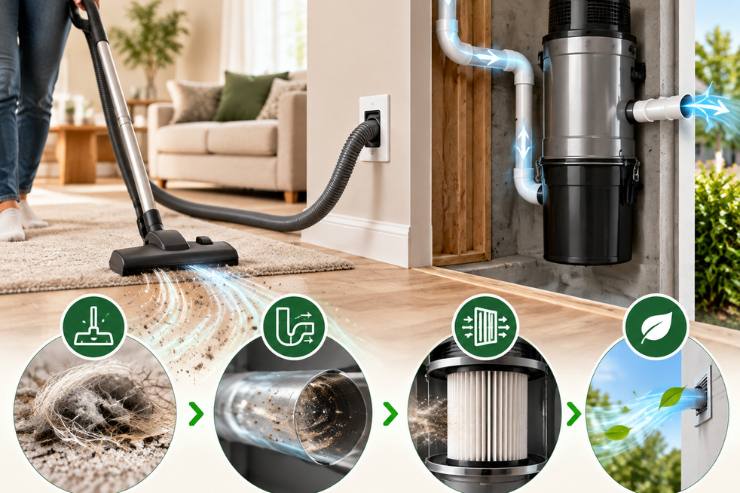
A central vacuum works differently from the machine you push around the room. Instead of pulling dust into a canister sitting right beside you, it sends everything through pipes built into the walls, out to a unit usually placed in the garage or basement.
That single difference changes where the dust actually ends up. With an upright or handheld vacuum, some of what gets picked up can escape back into the room through the exhaust. With a central system, that exhaust happens farther away from where people are living, working, or sleeping.
Filtration is where the real comparison happens. Central vacuum cleaning systems typically use larger filtration units with more surface area than a portable vacuum’s smaller filter or bag. A bigger filter often means it can trap more fine particles before air is released back out.
Here’s a simple side-by-side look:
| Feature | Central Vacuum System | Upright/Handheld Vacuum |
| Exhaust location | Away from living spaces | Directly in the room |
| Filter size | Larger, more surface area | Smaller, compact |
| Noise near user | Quieter at the vacuuming point | Louder, closer to you |
| Dust recirculation risk | Lower | Higher |
This doesn’t mean every central system outperforms every upright model. It depends on the specific unit, the filter type, and how well the whole system is maintained.
Different Systems, Different Filter Types
Central vacuums themselves aren’t all the same either. Two common types worth knowing about:
Bagged systems tend to keep dust more fully contained during disposal, while bagless systems cut down on ongoing bag costs but need a bit more hands-on emptying.
Filter ratings matter too. A HEPA-rated filter is built to capture a much higher percentage of fine particles than a standard filter, which can matter more for households with allergies or asthma. Not every central vacuum comes with HEPA filtration as standard, so it’s worth checking the spec sheet rather than assuming.
For households dealing with allergies, dust sensitivity, or pets that shed, where the dust goes matters as much as how much gets picked up. Here’s what tends to make a difference:
Results still vary from home to home, so it’s less about a guaranteed outcome and more about stacking small, sensible habits together.
A central vacuum only performs as well as its upkeep. Skipping maintenance can quietly undo the air quality benefit it’s designed to offer.
A few habits worth keeping in mind:
Skipping these steps doesn’t just reduce suction. It can also mean dust and allergens sit inside the system longer than they should, quietly working against the reason you have the system in the first place.
Think of it like any other part of the home that manages air, whether it’s a filter, a vent, or a duct. Left unchecked, even well-designed systems start working against you instead of for you.
Most homeowners can handle canister emptying and filter checks on their own. Some signs point to something a professional should look at instead, similar to how airflow issues in a dryer duct cleaning or air duct system often need a closer inspection than a homeowner can manage alone.
Watch for:
None of these mean something is seriously wrong. They’re simply signals worth checking rather than ignoring.
Whether a central vacuum makes a noticeable difference in your home depends on your filters, your maintenance habits, and the system itself. What’s clear is that where dust goes, and how well it’s contained, plays a real role in indoor air quality. The choice between systems isn’t one-size-fits-all, and that’s exactly why it helps to know how each one works before deciding what’s right for your household.
If you’re curious about how well your current system, or your air ducts, are handling dust and airflow, Universal Duct Cleaning has spent years helping GTA homeowners understand exactly that. Take a closer look at your home’s air quality picture, starting with the systems already working behind your walls.
Q1. Is a central vacuum genuinely better for air quality than a regular one?
It can be, mainly because exhaust air is released away from living spaces. The actual difference depends on filter quality and how consistently the system is maintained.
Q2. Do central vacuum systems need professional cleaning air ducts services?
Not usually the same service as home ductwork, but the piping can benefit from an inspection if suction drops or dust starts appearing near vents.
Q3. How often should central vacuum filters be checked?
This varies by model, but most manufacturers suggest checking every few months. Homes with pets or higher dust levels may need more frequent checks.
Q4. Can a poorly maintained central vacuum make air quality worse?
Yes, if filters are clogged or the canister overflows, trapped dust can start recirculating instead of staying contained, working against the system’s original purpose.
Q5. Is central vacuum cleaning worth it for allergy-prone households?
Many households notice a difference, though results vary. It’s one factor among several, alongside general cleaning habits and overall home ventilation.
Universal Duct Cleaning serves Toronto, Brampton, Mississauga, Vaughan, and the full GTA. Call for a free quote.
Book a free quote with Universal Duct Cleaning Inc. No pressure, no hidden fees.