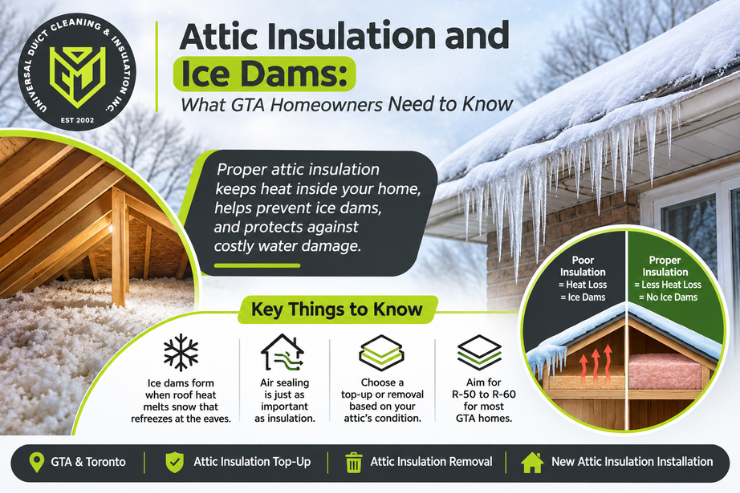
You look up after a snowfall and see it: a row of icicles along the eaves and a damp patch spreading across the bedroom ceiling. It’s a stressful sight. In most cases, ice dams begin with heat escaping into the attic. This guide covers why that happens, the signs to check, how top-ups and removals differ, and what R-value to aim for, so you can decide what attic insulation in Toronto suits your home.
An ice dam is a ridge of ice along the roof edge. It forms when heat from your home warms the roof, snow melts, and the water refreezes at the cold eaves. GTA winters make this easy, with heavy snow, a mild day, then a hard freeze. Water that backs up under the shingles can reach ceilings and walls.
Insulation works like a blanket between your living space and the roof. When it’s thin or uneven, more heat escapes upward and the roof warms unevenly. The Canada Mortgage and Housing Corporation (CMHC) notes that ice dams show up more often on homes with weak insulation or heavy warm-air leakage into the attic.
Good insulation helps in two ways:
Air leaks matter just as much.
Insulation slows heat down. Air leaks let warm air slip right past it, like an open zipper on a warm coat. Sealing the gaps first helps new insulation do its job.
Common leak spots to look at:
Two more things are worth a look:
A simple check can reveal early clues:
| What you notice | What it may mean |
| Snow melting unevenly on the roof | Heat escaping through thin or leaky areas |
| Icicles along the eaves | Meltwater refreezing at the edge |
| Ice building up in the gutters | Water backing up at the roof edge |
| Water stains on the ceiling or in the attic | Water getting into the home |
| Joist tops visible above the insulation | Insulation depth is likely below the recommended level |
One icicle isn’t a diagnosis. A pattern that repeats every winter is what to watch for.
A quick safety note: it’s best not to chip ice off the roof yourself. It can damage shingles and gutters, and an icy roof is risky to climb.
Both options have clear advantages. Which one fits depends on what’s already in your attic.
| Basis | Top-up | Removal first |
| Best when | Existing insulation is dry, clean, and just thin | Insulation is wet, mouldy, pest-contaminated, or very old |
| What you gain | Added depth on top of what’s there, usually a quicker job | A clean start and a chance to fix any problems first |
| What happens | Air gaps are sealed, then new blown-in insulation goes on top | Old material is vacuumed out, the attic is cleaned, then it’s re-insulated |
| Typical timing | Often about one day | Removal often takes 4 to 8 hours before re-insulating |
If your insulation is in good shape, attic insulation top up Toronto is a practical way to add depth. If it’s damaged or contaminated, attic insulation removal Toronto gives the attic a fresh start.
One more tip: homes built before 1990 may have vermiculite insulation, which should be tested by a qualified tester before anyone disturbs it.
Prices vary by contractor, attic size, and what’s already up there. As a rough 2026 market guide (before HST):
| Service | Typical range | Ballpark for a 1,000 sq ft attic |
| Blown-in top-up | $1.50 to $3.50 per sq ft | $1,500 to $3,500 |
| Removal of old insulation | $2 to $3 per sq ft | $2,000 to $3,000 |
Air sealing is often priced separately, and wet or moldy attics are usually quoted after an inspection. Every attic is different, so treat these figures as a general guide. For a price based on your own attic, you can request a free quote from Universal Duct Cleaning.
R-value measures how well insulation resists heat flow. A higher number means better resistance.
For most Ontario attics, the commonly recommended range is R-50 to R-60, and new-build targets in Ontario fall in a similar range. Many older homes sit well below that.
In practical terms:
If you’re planning attic insulation in Toronto, ask for the starting depth to be measured, so you know how many R-points you’re adding. Rebate programs may also be available, and eligibility often involves an energy audit first, so check current Ontario programs before you start.
Ice dams are common in the GTA, and they’re fixable. The root cause is usually heat escaping into the attic, which is why insulation and air sealing work best together. Whether your attic needs a top-up, a fresh start, or just a closer look, you now know what to look for and what each option offers.
A quick peek at your attic hatch and eaves this month is an easy first step. If you’d like a second pair of eyes, Universal Duct Cleaning offers attic assessments as part of its attic insulation in Toronto and GTA services, and can explain whether a top-up works better for you or a removal, so you can compare options at your own pace.
Q1: Can poor attic insulation cause ice dams?
Yes. Thin insulation and air leaks let indoor heat reach the roof, melting snow unevenly. That water then refreezes at the cold eaves, which is how ice dams build up.
Q2: Will adding more insulation alone stop ice dams?
Not always. Sealing air leaks and keeping attic vents clear matter just as much, and roof shape can play a part. A combined approach usually works best.
Q3: Do ice dams only happen on older homes?
No. They can form on any house. Older homes often have thinner insulation and more air gaps, which makes the right conditions easier to create.
Q4: Is it safe to chip ice dams off myself?
It’s best avoided. Chipping can damage shingles and gutters, and climbing an icy roof is risky. Fixing the cause is the safer long-term route, so consider starting there.
Q5: Can ductwork in the attic contribute to ice dams?
It can. Leaky or poorly insulated ducts release warm air into the attic, adding heat to the roof. Checking attic ducts is a simple part of the bigger picture.
Universal Duct Cleaning serves Toronto, Brampton, Mississauga, Vaughan, and the full GTA. Call for a free quote.
Book a free quote with Universal Duct Cleaning Inc. No pressure, no hidden fees.