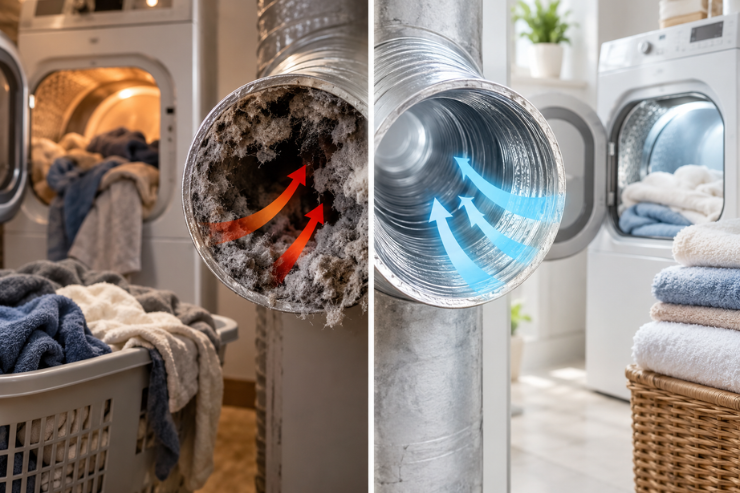
You toss in a load of towels, hit start, and walk away expecting dry laundry in under an hour. Instead, you come back to damp clothes and a dryer that’s still running.
If this feels familiar, your duct might be working against you, and quietly nudging your energy bill up along with it.
A dryer isn’t just about heat. It’s about heat plus airflow. Every cycle pulls in air, warms it, and pushes moisture out through the duct. When that duct is clogged with lint and debris, the airflow has nowhere to go.
Here’s what happens next:
None of this means your dryer is broken. It usually just means it’s fighting an uphill battle every time you do laundry, and that extra effort has to draw power from somewhere.
You don’t need a technician to spot the early signs. Your own laundry routine tells the story.
Take note if you’ve noticed:
| What you’re seeing | What it might suggest |
| Clothes still damp after a full cycle | Reduced airflow through the duct |
| Needing a second or third cycle regularly | The dryer is compensating for blocked exhaust |
| The dryer or laundry room feels warmer than usual | Heat isn’t escaping properly |
| A burning or musty smell during operation | Lint buildup trapping heat and moisture |
None of these are dramatic on their own. But together, they paint a pattern worth paying attention to, especially if it’s a gradual shift rather than a sudden one.
Many assume the lint trap alone is enough. It’s a great habit, but only part of the story.
| Lint trap | Duct |
| Catches surface lint | Collects finer particles that pass through |
| Needs attention every load | Builds up gradually over months |
| Easy to clean yourself | Needs a closer look further down |
Both matter, but they solve different problems. A clean trap doesn’t guarantee a clear duct.
Think about it this way: if a load that used to take 40 minutes now takes 55 or 60, that’s not a one-time inconvenience. It repeats with every wash, every week, month after month.
A dryer running longer than it needs to is simply drawing power for a longer stretch. It’s not about a dramatic spike, but about a gradual creep that’s easy to miss until you look at the pattern of your drying times over a few months rather than a single cycle.
Energy use is one part of the picture. The other is wear and tear on the appliance itself.
When a dryer has to push against restricted airflow, several parts are put under more stress than they were designed for:
Appliances are built to handle daily use, but they’re not built to constantly fight blocked airflow. Over months and years, that added strain can mean more frequent repairs or a shorter lifespan overall, and this is worth understanding as a maintenance consideration.
It’s fair to want to know what improved airflow can actually do for you. Here’s the honest, grounded answer:
What it doesn’t offer is a fixed number. No two homes, dryers, or duct lengths are identical, so a specific percentage saved on your bill isn’t something anyone can promise with certainty. What’s realistic is a dryer that runs closer to how it was designed to, which tends to reflect positively over time.
A few simple habits, both hands-on and observational, go a long way between professional visits:
None of these replace a proper duct check, but they help you catch a slow-building issue before it becomes a bigger one.
At the end of the day, a dryer that’s fighting restricted airflow isn’t dramatic, it’s gradual. Longer drying times, a few extra cycles, a bit more warmth in the laundry room. Small signs, but ones worth paying attention to, both for how your appliance performs and how long it lasts.
Staying aware of these patterns helps you catch issues early and keep your laundry routine running the way it’s meant to. If you’re looking to have your dryer duct checked and cared for properly, Universal Duct Cleaning has been helping homeowners across Toronto to keep their systems working the way they should.
1. What are the key benefits of professional dryer duct cleaning?
It clears lint and debris that everyday cleaning tends to miss, restoring proper airflow. This helps the dryer run closer to its intended cycle time and eases unnecessary strain on its internal components.
2. How often should dryer vents be cleaned to prevent fire hazards?
Most guidance suggests once a year, since built-up lint is a well-known fire risk in dryer systems. Homes with heavy laundry use or longer duct runs may want to check a little sooner.
3. How often should I schedule dryer duct cleaning?
Once a year works for most households, though factors like duct length, family size, and pets can speed up buildup. If drying times start stretching between checks, it’s worth looking sooner rather than later.
4. What are the warning signs of a clogged dryer vent?
Watch for longer drying times, clothes still damp after a cycle, unusual heat in the laundry room, a faint burning smell, or noticeable lint collecting around the outside vent flap.
5. What questions should I ask before hiring a dryer duct cleaning company?
Ask about their experience with vent systems specifically, the equipment they use, whether they check airflow before and after, and if they’re insured. Clear, confident answers are a good sign.
Universal Duct Cleaning serves Toronto, Brampton, Mississauga, Vaughan, and the full GTA. Call for a free quote.
Book a free quote with Universal Duct Cleaning Inc. No pressure, no hidden fees.